Developing a Social-First platform rethinking how people find flatmates and shared living spaces
Drey is a mobile-first platform designed to improve how people find flatmates and shared accommodation. Rather than focusing purely on listings, the product puts people, compatibility, and community at the centre of the experience.
The platform has been fully designed and developed, with the product now moving into its rollout and launch strategy phase. Drey represents a complete end-to-end product build, from early concept and validation through to delivery and go-to-market planning.
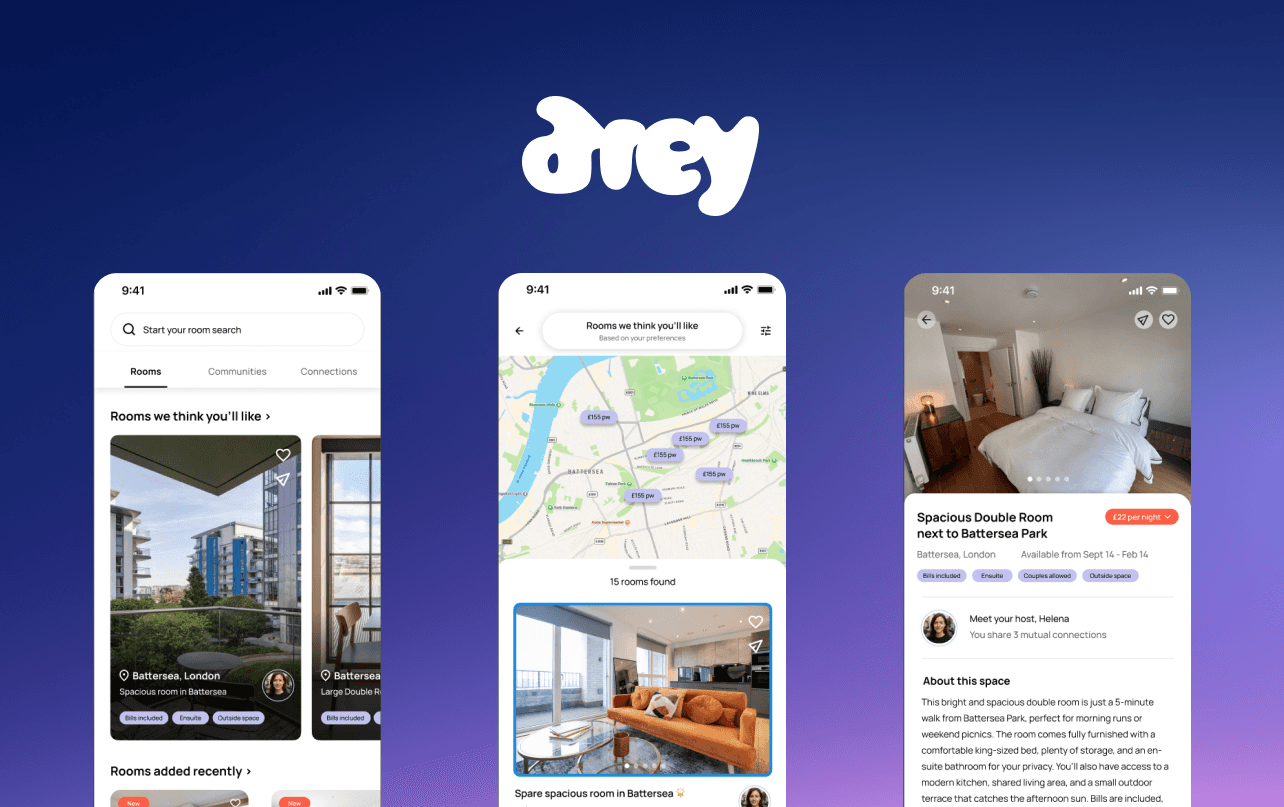
Drey
Product Lead & Delivery Lead
Mobile App (iOS + Android)
Product Lead & Delivery Lead
Product Owner
Technical Architect
UX Design
Project Manager
Built - Preparing for Launch
The Problem
Now this has been an exciting project and one that has been extremely fun to head up. Drey answers so many of the right questions and solves challenges that I faced when I was looking for a flat years ago.
Finding a place to live isn’t just a property problem, it’s a people problem. Most existing platforms prioritise rooms over relationships, resulting in poor matches, uncomfortable living situations, and high churn. Users are often forced to make decisions with limited insight into who they’ll be living with, relying on minimal profiles and transactional messaging.
The problems that the client identified early on included:
Little emphasis on flatmate compatibility
Weak signals around lifestyle, values, and intent
Awkward or unsafe early communication
A process that feels impersonal for a deeply personal decision
The opportunity was to designs a platform that felt more human, social and intentional without sacrificing usability or scalability.
My Role
I acted as Product Lead and Delivery Lead, responsible for the product end-to-end version 1 cycle. My role covered:
Defining the product vision and value proposition
Leading discovery and validation
Designing core user journeys and UX flows
Defining MVP scope and roadmap
Overseeing technical planning and development
Supporting launch and rollout strategy
This role blended strategic product ownership with hands-on UX leadership and delivery oversight.
Process
Discovery & Product Definition: The project began with deep problem exploration, focusing on user behaviour, trust, and emotional friction within shared living. The key activities that I carried out alongside the founder were:
Mapping real-world flatmate journeys
Identifying trust and safety pain points
Defining clear user types and use cases
Translating insights into a focused, buildable MVP
This ensured the product addressed real user needs rather than assumptions.
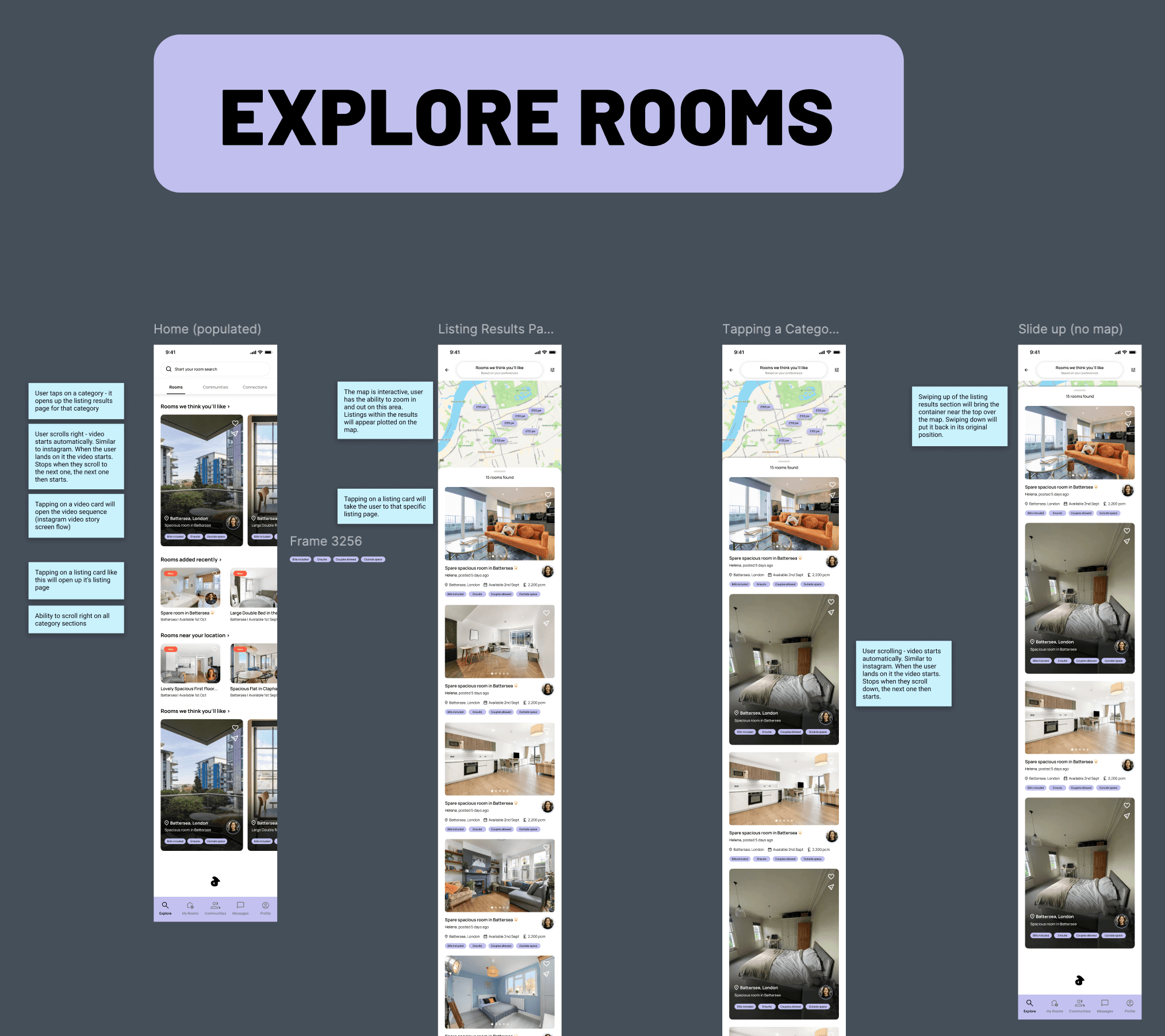
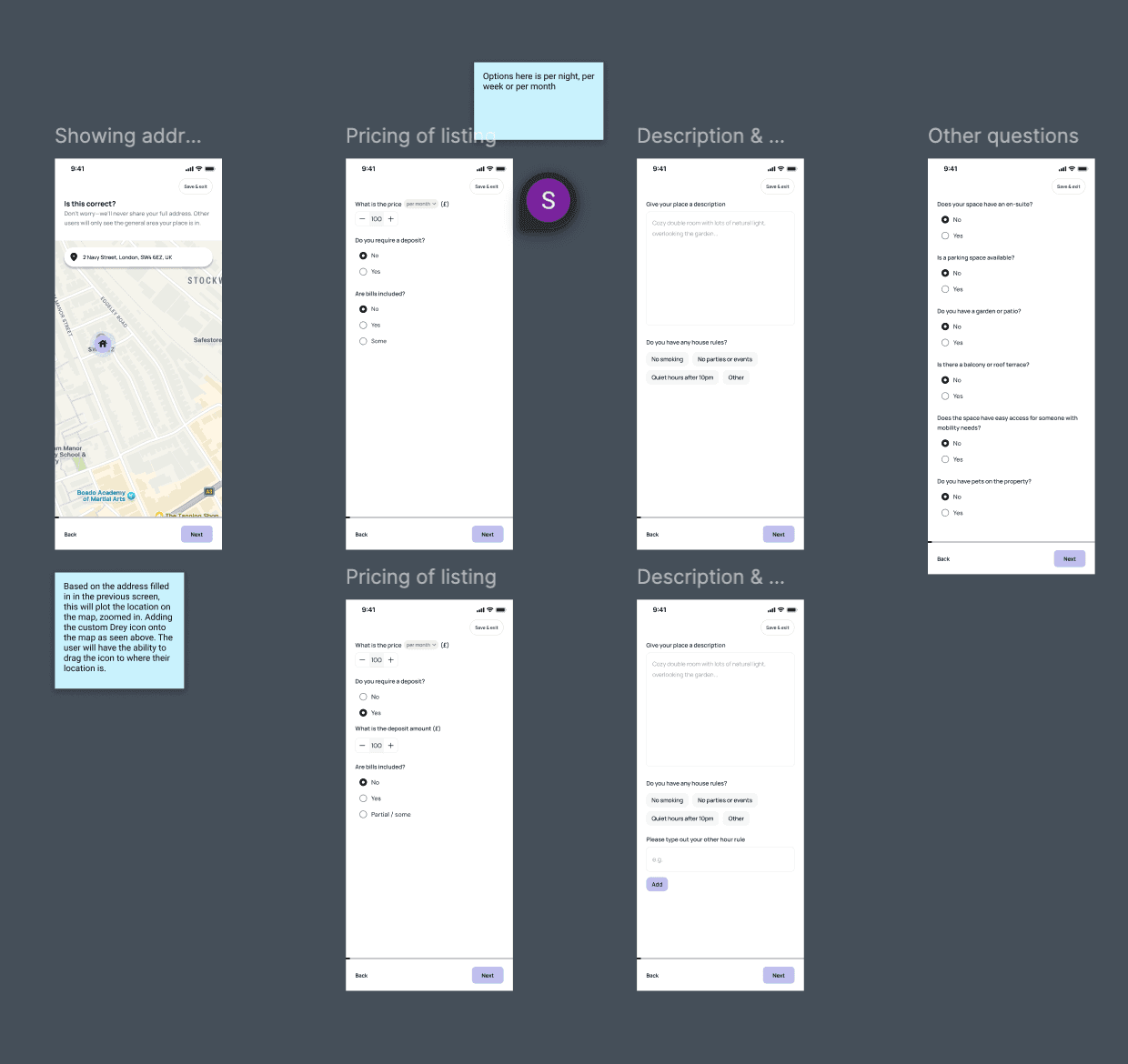
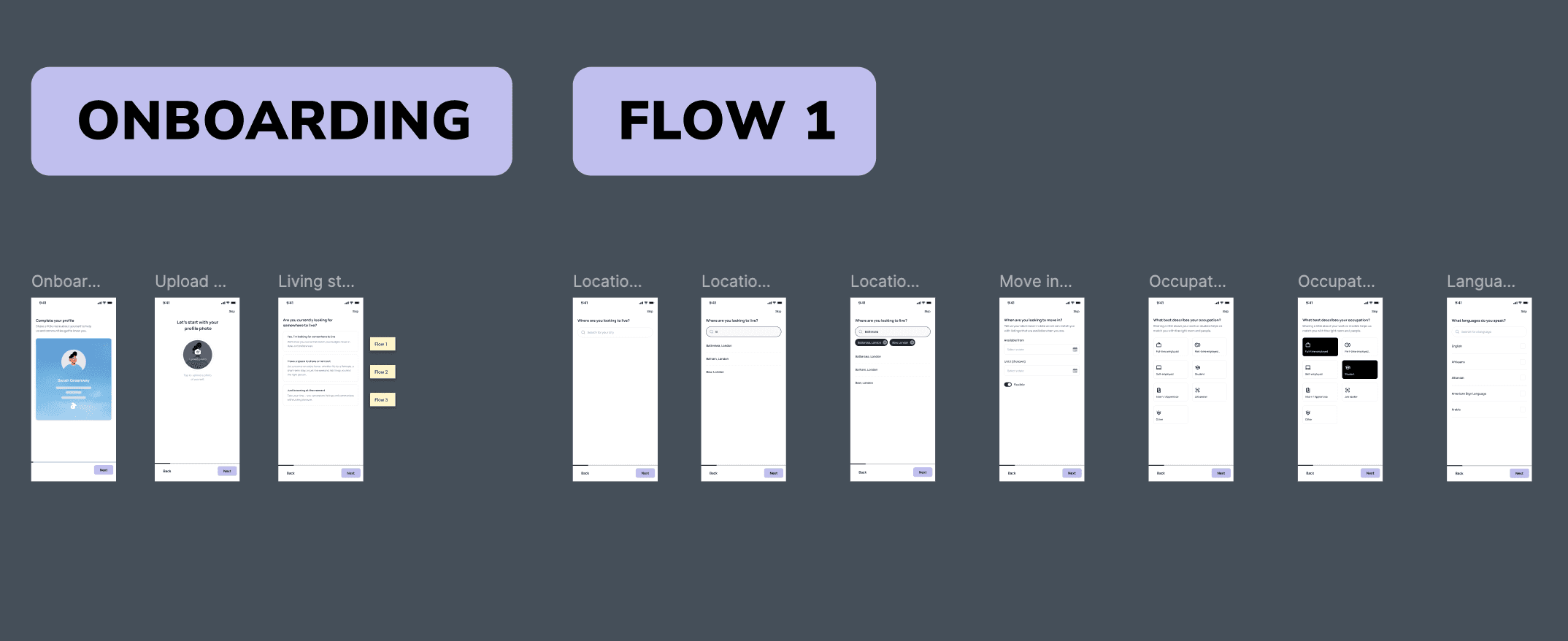
UX & Product Design: I designed the platform to feel human and intentional, placing people at the centre rather than leading with listings. Clear signals around compatibility and user intent help users make more informed decisions, while thoughtful onboarding sets expectations early and builds confidence. A clean, modern interface reinforces trust and ensures the experience feels approachable. All user flows were designed with scalability in mind, allowing the product to evolve naturally as new features and capabilities are introduced.
Development & Technical Delivery: The platform has been fully developed, with technical decisions made to support long-term growth and flexibility. Flexible data models were implemented to support discovery and matching, alongside a modular architecture that allows features to evolve without major rework. A clear separation was maintained between MVP functionality and future roadmap items, ensuring the product could launch lean while remaining extensible. The platform was also prepared for analytics, iteration, and optimisation post-launch. Throughout development, close collaboration ensured that product intent and UX decisions were preserved through to implementation.
Key Decisions & Trade-offs: A key decision was to avoid over-engineering social and matching features in the initial release. Rather than introducing complex automation early, the focus was placed on strong onboarding, clear user intent signals, and simple, meaningful interactions. This resulted in a clear, testable MVP that reduced risk and supported faster learning. The approach allows the product to adapt based on real-world usage after launch, rather than assumptions made too early in the process.
Current State & Rollout: Drey has been fully built and is now entering its rollout phase. Current focus areas include launch sequencing, onboarding strategy, early user acquisition, and establishing feedback loops to capture meaningful insights. Engagement and behavioural signals will be closely monitored, with features iterated based on real usage data. The platform is well-positioned to launch with confidence, supported by a clear and structured roadmap for post-launch improvement.
Conclusion
Drey reflects my approach to building early-stage products that are designed to learn and evolve. By grounding decisions in real user behaviour and resisting unnecessary complexity, the platform is ready to launch lean and improve quickly.
This project showcases my ability to own the full product lifecycle, from concept and design through development and rollout, while keeping both users and long-term scalability front of mind.