Creating a cloud-based property management platform for social housing developments.
Probably one of my most complex SaaS projects to date, Nexgen is a property management software platform designed to help UK housing associations oversee the build and development of social housing schemes. The platform acts as a single, intuitive system for managing projects, workflows, cashflow, compliance, risk, reporting, and documentation across the full lifecycle of a development.
My role on this project was heavily focused on planning, specification, UX design, and technical translation. Turning complex, domain-heavy requirements into clear user flows, structured features, and a development-ready product definition.
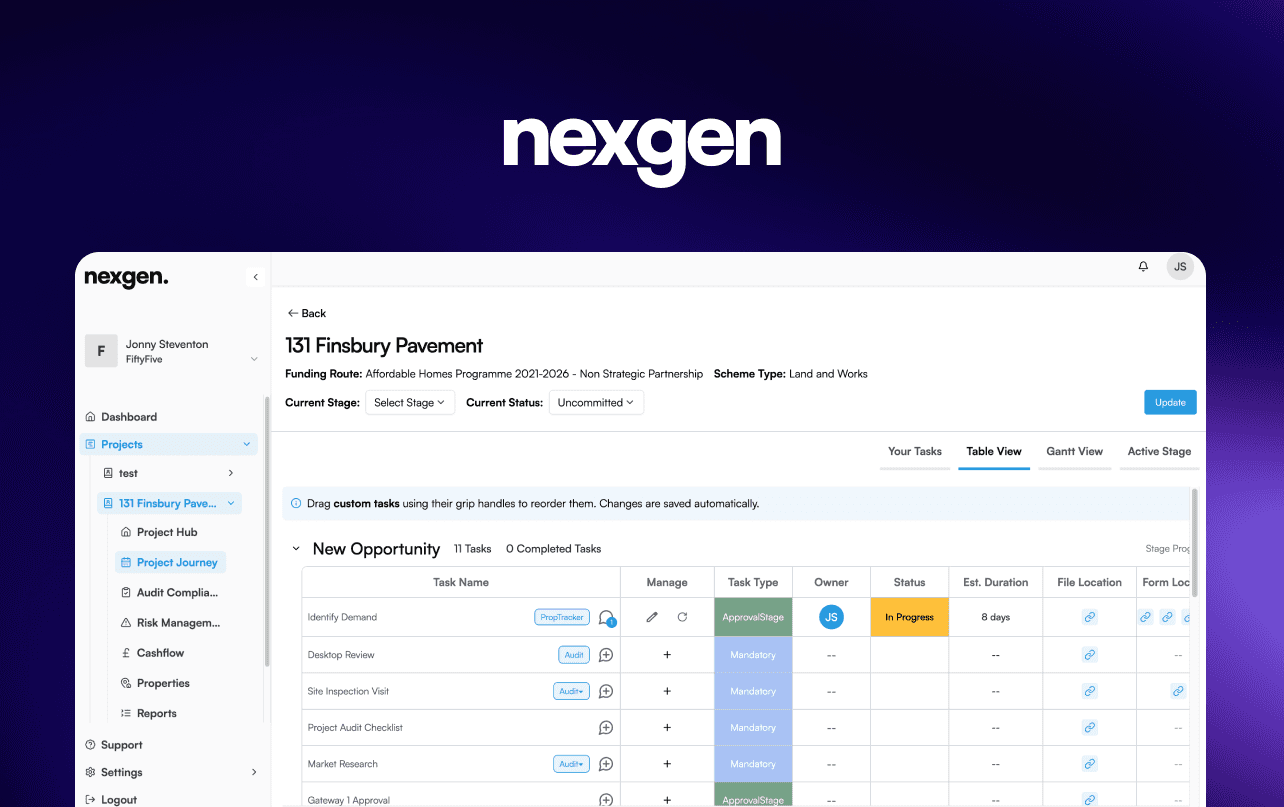
Nexgen Development
Project Type
SaaS Platform
Industry
PropTech
80 - 100k
Requirements Planning
PRD Generation
Wire-framing & Userflows
UX Designs
Technical Documentation
Challenge
Property management software within the social housing sector is widely outdated, fragmented, and difficult to use. Despite paying high licence fees, many organisations only utilise a small fraction of available functionality due to poor usability, steep learning curves, and weak onboarding.
Key challenges included:
Highly complex workflows spanning multiple stakeholders
Heavy compliance, audit, and reporting requirements
Financial and cashflow data tightly coupled to projects
Existing tools prioritising features over usability
A lack of modern SaaS UX standards in the sector
The opportunity was to design a modern, user-friendly platform that could support highly technical processes without overwhelming users.
My Role
It was my responsibility to work as the Product Lead and UX Lead throughout the initial stages of the project before the team commenced the development phases. I was responsible for shaping the product from discovery through to development.
Key tasks included:
Undertaking several stakeholder workshops to understand the breadth of the system requirements
Translating stakeholder requirements into structured features
Designing end-to-end user journeys and flows
Producing the full Product Requirements Document (PRD)
Creating wireframes and UX designs
Designing a clickable prototype in Figma
Explaining product logic and flows to the lead developer and engineering team
A key part of my role was acting as the bridge between non-technical stakeholders and a highly technical development team.
Results
Based on my work throughout the Technical Planning and Design phases, I was able to successfully conduct the handover to the development team. With my comprehensive planning and detailed UX designs, the lead developer was able to understand all requirements and user flows to commence to the development phase.
Fast forward 8 months Nexgen have started to onboard their first early adopters and have also commenced version 2 of their pipeline.
Process
Discovery & Requirements Definition: The project began with deep discovery across multiple functional areas, including project management, finance, compliance, risk, and reporting. My focus was on understanding how hosing professionals actually work day-to-day, rather than simply replicating systems.
This involved:
Breaking down complex operational processes
Identifying core entities and data relationships
Defining a project-first data model
Seperating essential first version functionality from future features
All requirements were captured in a detailed PRD that balanced clarity with technical depth.
UX Design & User Flows: UX design focused on simplifying complexity without removing capability. Key UX principles included:
A project-centric structure, where all data flows from a single source of truth
Clear navigation across core areas (Workflow, Cashflow, Compliance, Risk, Reports, Files)
Consistent interaction patterns across highly different feature sets
Table-based and structured layouts inspired by tools users already understand
Complex areas such as workflows, compliance tasks, and risk logs were designed to feel familiar, flexible, and auditable.
Technical Translation & Development Handover: A critical part of the project was ensuring the product vision translated cleanly into build.
This included:
Structuring features into clearly defined components
Designing systems to support multiple workflow templates
Defining how files, tasks, compliance items, and risks interact
Mapping third-party integrations and APIs
Aligning UX decisions with database structure and reporting needs
I worked closely with the head developer to walk through flows, edge cases, and system logic, ensuring there was no ambiguity before development began.
Usability Testing: We conducted usability tests with a diverse group of users to validate the design and identify areas for improvement. Based on the feedback, we made necessary adjustments to the design.
Visual Design & Style Guide: We developed a cohesive visual language, including color schemes, typography, and iconography, ensuring consistency throughout the app. We also created a style guide to maintain design consistency in future updates.
Conclusion
This project is a strong example of how I approach highly technical platforms. By grounding decisions in real user workflows and structuring requirements carefully, I was able to turn a complex problem space into a clear, build-ready product.
It reflects my ability to operate confidently at the intersection of product strategy, UX design, and technical delivery, particularly in environments where clarity, compliance, and scale are critical. It was a challenging project due to my limited knowledge within the PropTech space. The workshop session I conducted with Nexgen stakeholders was crucial to the success of the first version build.